
Interview with Amy Boone McCresh
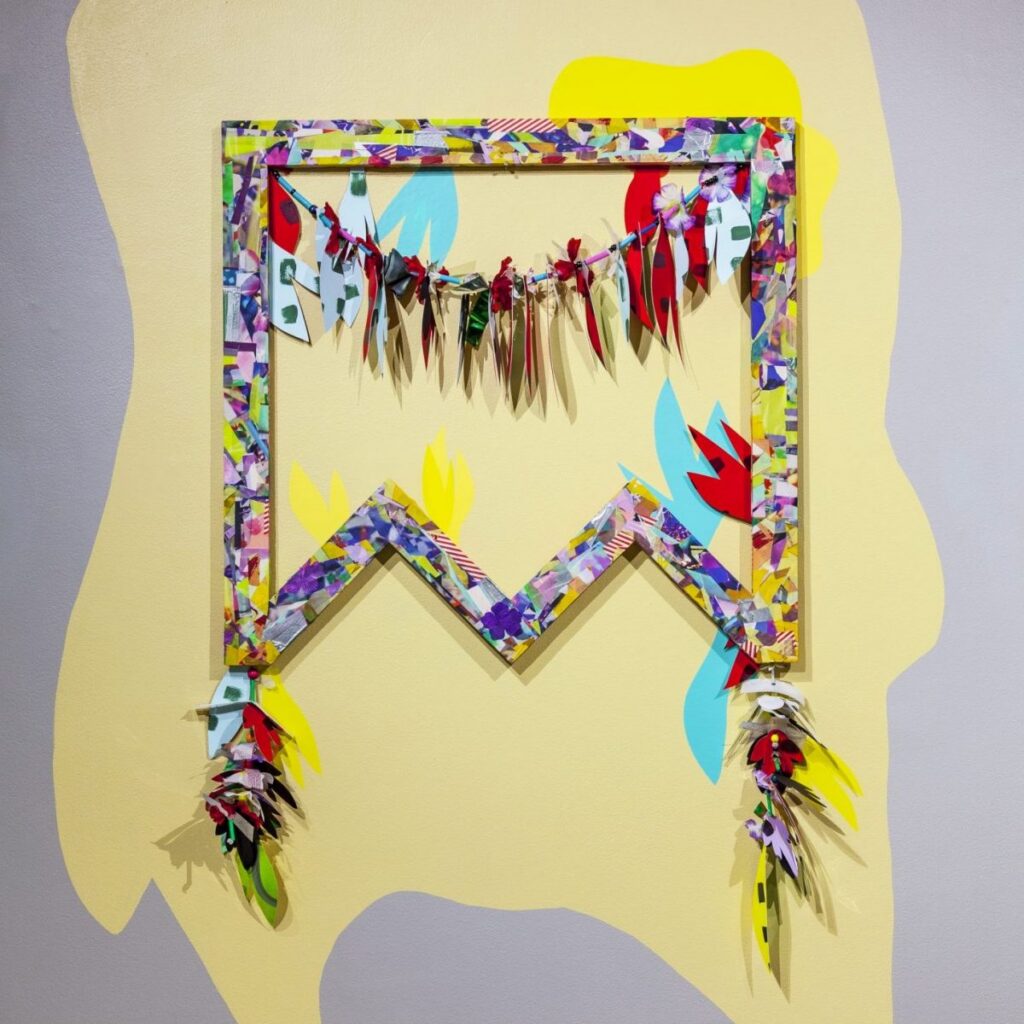
Interview with Amy Boone McCresh Exhibiting artist at 355 Pod space from October 16 2020 – January 17 2021 interviewed by Iona Nave Griesmann. The signifiers of status and class present themselves culturally in overt and nuanced ways. Logos of high fashion, cars, and grand architecture are predictable ways to display wealth, even if it is perceived. What about the subtle visual ways culture and society delineate class? Class is evident from the view outside one’s window, the level of access and choice in self-care, to the types of fabric in a home. I use an abstracted version of this materialistic visual vocabulary to ask questions that challenge classist structures, but also to tantalize with maximalist aesthetics. Highly saturated colors and a rich variety of textures create an initial attraction, while at the same time questioning assumptions of “good” taste. With this work, I push against the cross-cultural ideas of beauty and perception of class. This maximal and decorative aesthetic is partnered with detailed and hand-driven processes often associated with craft. The utilization of technology and digital components are combined with the handmade processes to create a direct shift in value and labor. These decisions aim to mimic the seemingly arbitrary lines that are drawn to signify cultural markers of luxury, mass production, and the defining features of access. To kick things off, would you like to talk more about your pieces currently being shown in the 355 VisArts Pod Space? The piece up in the Pod Space is called Room With a View, and it’s a loose or deconstructed representation of interior and exterior existence, which I think has been on a lot of our minds right now, thinking about views out of our windows. Weirdly, last fall I started a series that was actually based around this idea of windows, and that was pre pandemic. I was thinking a lot about what the view out of your window says about your social status, class, access and position in the world. It says a lot if you’re looking at a brick wall, a parking lot or a beautiful garden. I wanted to capture it using the language of architecture and a fleeting environment, and then some abstract moments of color and light to have a conversation around that idea. The Window, 2017, Wood, custom fabric, mixed media garlands, cut paper, 44” x 32” x 3” The Window, 2020, Detail What are some of the thoughts or ideas you have that are specific to the themes of architecture? During the pandemic I started photographing my own windows during the day. I live in a little carriage house in Baltimore city, and part of that carriage house looks into an alley which is pretty unappetizing to look at. It’s also an old house, so we have these really big windows which sounds really grand, but we actually had to put this frosted window vinyl on them so that people couldn’t see in. So we get all of these muted shadows and colors, and because I’m home all the time I was able to see how it was illuminated throughout the day; these few specific windows and how the light was changing. I just became hyper aware of that. Some of the patterns you see on the silk in the window space are actually patterns made from those photographs of my own home and my own view. And then, the bars on the windows are kind of adopted into the language of the window shapes that are hanging in there as well. I notice that frequently, and especially in your exhibition “The Artificial Order of Things” you employ motifs and elements of nature that are made from man made materials. Can you talk more about this juxtaposition in your work? I’m always thinking about this idea of beauty; that it exists and occurs naturally, and we think of ways to harness it whether that means cutting flowers and having bouquets, or having a really beautiful yard. Even pets in a weird way are capturing beauty. It’s a strange way to think about something that’s already existing without us, and we are appreciating that beauty, harnessing it and holding it. And who has access to that beauty? I watched Real Housewives for a season; I think it was Los Angeles, and one of the women had this massive bowl of fresh lemons and limes from her garden. And I was like “wow, just to have a massive bowl of fresh lemons and limes from your own yard for you to use and display in all of its glory is such a wealthy thing”. I guess the sub context here is that I am a first generation college student, my mom was an immigrant and I grew up pretty poor. I guess I’ve had this hyper awareness of how people display wealth even if it’s not deliberate, obvious or intentional. Like how fresh food is actually an issue of access. I’m also really interested in interior spaces and design for the same reason. How we decorate our spaces, what do those spaces look like, what is the ceiling height, what are the windows. And also the way that we live indoor and outdoor space really says a lot about us as people, as a society, as cultures. The Artificial Order of Things, 2015, site-specific window installation at Mixed Greens gallery, NYC The Artificial Order of Things, 2015, Detail, Learn More about The Artificial Order of Things Have you always had questions on how decorative choice connects to class and status? Or have you had any experiences that drove you to ask questions about these topics? Like I said, growing up in home that was not really of means. It was my sister and I, my mom worked three jobs and she wasn’t a citizen until I was in elementary school. At a very young age I was really aware of what we had and did not have; you know when you visit