
Aaron Maier Interview
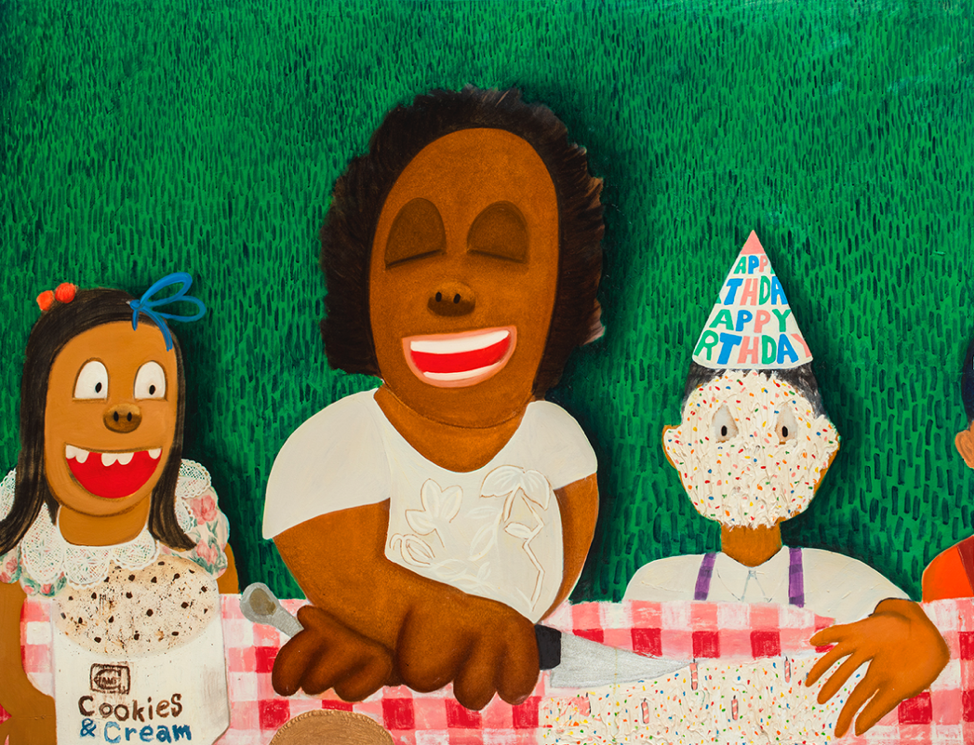
Interview with Aaron Maier VisArts Next Generation Studio Fellow By Iona Nave Griesmann Aaron Maier is a Latino visual artist born and raised in the Maryland suburbs of DC. He obtained his B.F.A. from the School of The Art Institute of Chicago, attended the Skowhegan School of Painting and Sculpture, and has exhibited at the Queens Museum in New York City, SculptureCenter, The National Arts Club, The Art Institute of Chicago, the Museum of Contemporary Art Chicago, and the Washington Project for the Arts. Aaron lives and works in Washington, D.C. What are you working on for VisArts? Do you have any goals you would like to achieve during your residency? Right now, I’ve been doing a lot of ink drawings and paintings. I came here with this idea that I was going to try something a little bit different from what I’ve been doing in my other studio at home. It’s opened up my practice a lot more because the ink by nature is very fast. Once you put it down, that’s it. And the newsprint is not precious, so I’m just pushing ideas out. So that was kind of my plan. To make a lot of work that felt raw and unfiltered, and then to see what’s there. Why do you employ cartoons to illustrate your stories and ideas, and how does cartoon symbolism amplify the meaning of your work? There’s an immediacy to them, and I can paint in a very observationally realist sort of way. When I’m working, I’m thinking about my feelings, and I’m thinking about things that give me something profound, so I start with something that’s very intense. To me, a cartoon is the quickest way to portray that onto a piece of paper. If you’ve ever drawn something in Pictionary, you have a timer and you just have to draw as quickly as you can. I find that when you are working in this sense of immediacy, things come up that you weren’t even anticipating because you’re so directly involved. You just happen upon these things. And they’re yours, they’re gifts. I think cartooning amplifies the meaning of my work by being very distilled. If you look at the use of cartoons or abstracted things, you get something that is very specific without being loaded with other things. In everyday life, if you look at a bathroom sign, its very clear that the icon is a type of person, whether gendered or non gendered or somebody who’s disabled. That’s the main point. So I just want to be very specific. I have these complex things that I’m uncomfortable with, but I want to be as clear about them as possible. I think cartooning in a way, opens up my work. I don’t take it seriously when things are cartoon. I don’t struggle as much to find different ways to pull ideas of judgement on what art needs to be, or what my art needs to look like. I just respond directly to what I’m making, and that’s usually more authentic. Corte Militar, 22 1/4 x 30 inches Your mark making is noticeably distinctive and expressive. Do you seek to portray different emotions or themes using different kinds of strokes? I think it’s an intuitive response. The more warmed up I am with my hands, the more controlled my marks tend to be. I’m also trying to emulate what my relationship is to whatever I’m drawing. Usually that happens with the type of mark I make, whether it’s the pressure, or the length of the stroke. If I’m drawing something and I want to be sort of romantic about it, my strokes are much longer and light. If I’m feeling angst, or some kind of convoluted feeling, then they’ll be a little more scratchy. And it depends if I’m drawing something like flowers, and how I feel about a particular petal, or if the stem feels kind of bold, rigid or feeble. I’m responding with marks, and trying to use that amount of pressure in a way that I interpret what I’m seeing. I want to bring my judgement of the object, and the way something feels visually into the work. Your artist statement reads that your work is influenced by the works of Chicago Imagists such as Barbara Rossi, Roger Brown and H.C. Westermann. What about their work inspires you, and do you employ some of the techniques they use in your own work?’ I studied with Barbara Rossi, and I really like H.C .Westermann’s and Roger Brown’s work. What gets me excited about a painter is when I see something that I haven’t seen before or didn’t feel was possible, and I’m like “Oh, you can do that?” When I was in art school I hated Cy Twombly’s work. It was scratchy, and it felt like “my kid could do that type of work”. But I pushed myself to really learn more about why that work was considered art, and why people actually said “No this is important!” It gave me a way to say “Well if everything and anything is possible, I can do anything.” Roger Brown specifically has a very interesting way of creating clouds, landscapes and buildings that are so imaginatively unique. Like, he can do a building in the shape of a snake, and the clouds look like rocks in the sky, and it’s believable! To see something impossible in artwork is exciting to me. It just adds to this validity of your own sense of weirdness. If you’re an artist who’s interested in weird things, then you give yourself more permission to explore and embrace that, which ultimately adds to this authentic sense of self within your work. What experiences or questions did you have that helped you decide to center some of your work around memory, masculinity and race? When I was growing up, my parents didn’t make a big effort to explain the whole problem