
Gray Lyons Interview
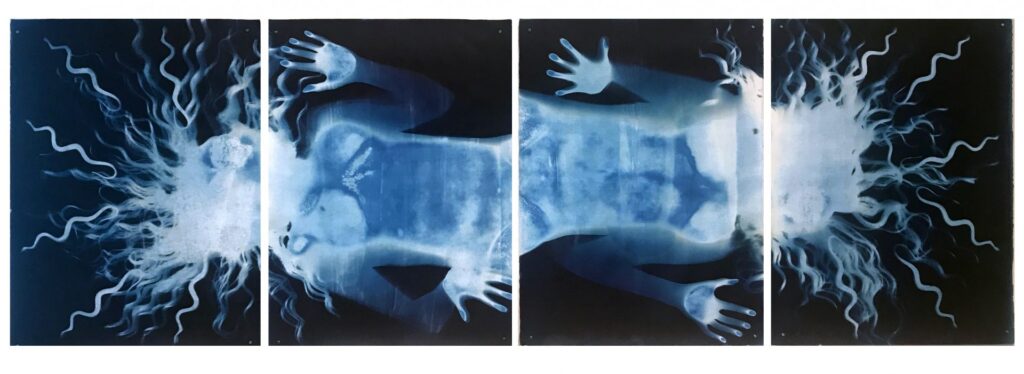
By Noa West, VisArts Summer Intern, 2017 Cyanotype is an antique photographic process that was invented in the mid-1890s. Known for its rich Prussian blue color and ability to be applied to a broad range of non-traditional surfaces, including fabric, wood, and pottery, cyanotypes have sparked a renaissance in contemporary photography. Despite its newly discovered versatility, artists continue to be limited by this age- old practice, as the outcome can often result in a flat image, and the process imposes inherent size restrictions. Gray Lyons defies these limitations—her mastery of the cyanotype process has led her to create works over five feet in length, using innovative techniques that create visual depth and perspective through the manipulation of exposures. By using impressions created by her own body, Lyons’ relationship with the work enhances the aspects of storytelling, memory, and history. These messages relayed by her work are strengthened through the medium of cyanotype, as they are “a (physical) record of the air, water, and sunlight on that day on that time,” which connects stories of the past directly to the present. The result is Lexicon; a body of work resembling a portal going into a watery world—or perhaps a glowing womb. The work was on view at VisArts from July 14 through August 27, 2017. What is the process of creating a cyanotype It is a process that can be done really si ply, and then become hair-pullingly complicated. It requires only two chemicals, but once you learn to coat the paper effectively, it’s relatively easy to get a decent exposure. My wife always says, “It takes forever, and then all of a sudden it works.” I coat the paper with potassium ferricya ide and ferric ammonium citrate in even amounts, a number of times, in the dark. This combination creates a light-sensitive emulsion that you then paint onto whatever surface you are using. In the case of the images I have in the show, the base is watercolor paper I coat the paper anywhere from three to five times depending on what I have in mind. The paper has to completely dry in between coats, so I’m usually standing in my studio in the dark for about 12 hours coating the paper. When the last coat is dry, I bag it up in opaque bags so that the light does not read through it. We then move outside; it then takes two people to lay it on a sheet of hard board so that it doesn’t wrinkle when I lie down on it. Most of the time I am just using my body on the paper directly to make the image. It also helps when it’s a really hot, humid, and sunny day; as you sweat it activates the chemicals, that’s when you can really depict every hair and pore on the skin. To create highlights, you push your body into the paper as hard as you can, so on those places where the contact is the hardest and no light can get around the body—that’s where it’s the lightest. Weight and pressure are essentially the same thing. Hair is really dense, so light reads around it instead of through it. As I lay in bright sunlight, the coated paper begins to expose. In 25 to 45 minutes, the paper turns from a yellow-green to a silvery-brownish color. I always call it a ‘fox’ color, which probably drives my students crazy. Once it turns that color, I get up from making the impressions and wash out the iron sulfate by dipping the work in four kiddie pools. As soon as it hits the water, the work turns dark blue and the highlights are brought out. After it has been completely washed, it then starts to oxidize; within 24 hours, the color becomes a rich, deep blue. Let’s talk about the message you want to communicate through your pieces. Do you think that cyanotypes enhance these messages in your work? Oh, all of them. I went to art school and trained as an artist, almost all of my work has been silver prints (darkroom-based printing), but I have experimented with pretty much all of the ways to photograph. I wanted to make sure that I knew about all of the possibilities available, and to be conversant in each technique. However, I am not only attracted to the outcome of using cyanotypes; the physical process enhances the messages that I am portraying through my work. There is not one particular overarching message that all of my work is about. In general, all of the pieces I make refer to storytelling, memory, and history. Because cyanotype is an antique process—it’s a historical process—it starts to make that reference automatically to the past. There is also a physical relationship with the environment in order to create cyanotypes. You can make the work in a really clinical way—you can make it indoors, under a bank of UV lights, and use a timer—but I love being outdoors. That moment of the unknown, where maybe it will go perfectly, or maybe the wind will blow and the paper will go flying across the yard and it won’t work out, or the sun will go behind a cloud and the image will change entirely; each image literally contains the natural world and natural elements. It’s a record of the air, water and sunlight on that day on that time. Is there a deliberate reference to water or any other natural elements in your work? Yes, absolutely. There aren’t any in the show at VisArts, but I’ve been working on a whole series of images about freediving, and the intelligence of the body overcoming its own physiological limitations. I’m really interested in water as something that contains us in the first months of our lives, but also, we contain it; we are made so much of water. There are ways to tone cyanotypes so that they aren’t blue anymore, but I’ve always really loved that deep blue that
Procedural Experience: An Interview With Aaron Oldenburg
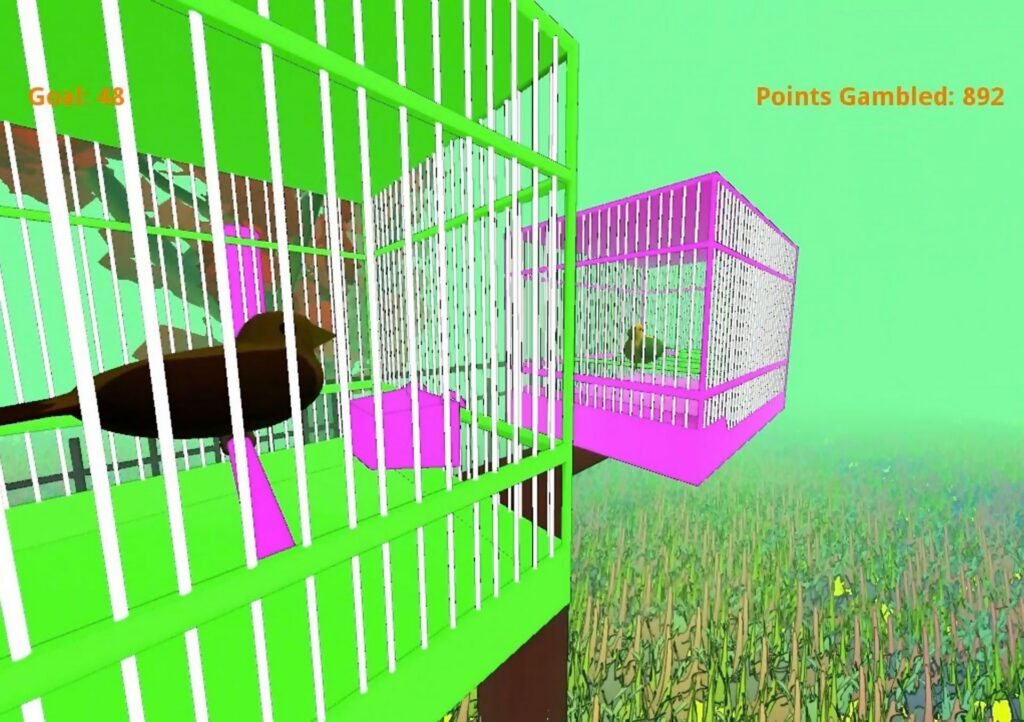
By Noa West, VisArts Summer Intern, 2017 Aaron Oldenburg is a game designer and new media artist. He presented a series of experimental video games in his first solo exhibition at VisArts, Procedural Experience, July 12 – August 27, 2017. The element of interactivity is a unique facet of contemporary art that has been explored in a variety of mediums. As the breadth of game design continues to expand, the artist, as game designer, has the ability to create a simulation of time and space through the virtual medium. A video game is a simulation of a moment, an experience, or an alternative reality. From my conversation with Aaron, I learned that a player does not always have control over their avatar. Games can be virtual experiences that force the player to see through the eyes of the avatar. In order to understand game design as an art medium, I did some research. One of the most interesting discoveries was a game called That Dragon, Cancer, released in 2015. Ryan Green, the game designer, based the game around his young son who was battling terminal brain cancer. Green launched the game while he was in the hospital with his son, who, at the time, was in pain. No matter what he did to aid his son, whether reading to him, rocking him, or attempting to give him water, his son would not stop crying. This painful memory is simulated in the game, which requires the player to undergo a similar experience of consoling a child, that might cause one to feel agonizing emotion. Games have the potential to not only simulate memories, but also to recreate experiences. Many indie game designers, including Aaron Oldenburg, are interested in engaging a player’s empathy. Aaron’s work interconnects empathy, philosophy, culture, and activism. Interestingly, Aaron’s love for social work has permeated his work as a game designer. Experiences working at the HIV/AIDS Hotline in Tallahassee, Florida, as well as an HIV Health Extension Agent for the Peace Corps in Mali, West Africa, helped turn him into a multidimensional artist. Now, he is able to express his interest in exposing different stories and perspectives through an alternative medium. Aaron teaches this game design medium at the University of Baltimore, where he contributes to the proliferation of video games in the art world. How do you define a ‘game’? I’ve kind of fallen on different sides of this. There are a bunch of definitions; one that I used to go by was it must have goals, consequences, obstacles, and an end state that’s unpredictable. I felt it was important because it gave you an expressive vocabulary that other art forms do not have, and you can use that. Ian Bogost talks about procedural rhetoric, and the way games communicate their ideas is through the mechanics, by what they cause you to do. In my games, I have gone the opposite direction, feeling like our job is really to create obstacles. I felt like I did not need to go through the whole checklist of everything of what a game has to be like in my work, and by doing that it’s not a “full game” and it’s not making the most of all the vocabulary that games have. Some of the most interesting things that call themselves games are either not doing one of those things or doing the opposite of what’s conventionally being considered a game. Some of those only make sense if you call them a game, because they are intentionally breaking those rules. It’s not really helpful to restrict a game definition because there is so much interesting stuff happening that would get ruled out if you kept it restrictive. Can you elaborate on rules that you ‘break’ as an indie game designer? Instead of saying “breaking rules,” I should have said “breaking with expectations of the game format.” For instance, in the game Thinning, the gameplay initially looks like that of a standard “rogue-like style” game, a generally 2-D procedurally generated dungeon crawler. But as one moves through the rooms, instead of encountering monsters to kill, the camera zooms out, showing the same room repeated, with the player character moving in the same patterns through seemingly infinite rooms. These repeating rooms turn into curving patterns, and eventually the player is not focused on controlling their character, but navigating this world turned into patterns through empty space. It’s an attempt to give the player a sense of depersonalization, and it helps the experience if the player begins with the expectations of the particular type of game into which they’re initially dropped. A sillier example is my game Furrowed Brow, which is a wearable game attached to a wig, that takes the form of one of those games where you are supposed to catch a falling object. Only the game itself decoratively replaces the furrows in the player’s actual forehead with an animated line in the game, so it is unclear whether the purpose is to play or to display the game as a costume. In general though, many of my games eschew the “overcome a challenge to achieve the goal” style of play. What are aspects and perspectives that game designers and artists have in common? Do you think their goals converge? Well, as a solo game designer, I end up playing the roles of visual artist, musician/sound designer, and narrative designer, and each of these have similar processes to their non-game variants. I think where they diverge, generally, is that game design is a process of opening up and letting go, more so than in some other art forms. Because your games are not a part of the ‘gamer’ demographic, what is your target audience? People who play weird games like me. (Laughs)There’s a subset of videogame-players, some of whom identify as “gamers,” some who don’t, who are interested in games that are somewhat smaller, more personal or experimental than mainstream indie games. These games have most recently come under the term “altgames.” Has your experience in social work intervened with your approach in game design? I think so, yeah. I have previously made connections between counseling and my work. Before I worked for the Peace Corps in Mali, I was a counselor for the HIV/AIDS Hotline in Tallahassee, Florida, for five years. Through that experience, I have
Rachel Schmidt Interview – NOT EASY BEING GREEN
bY Karen Schafer / Nov.30.2017