
Interview with Mia Eve Rollow
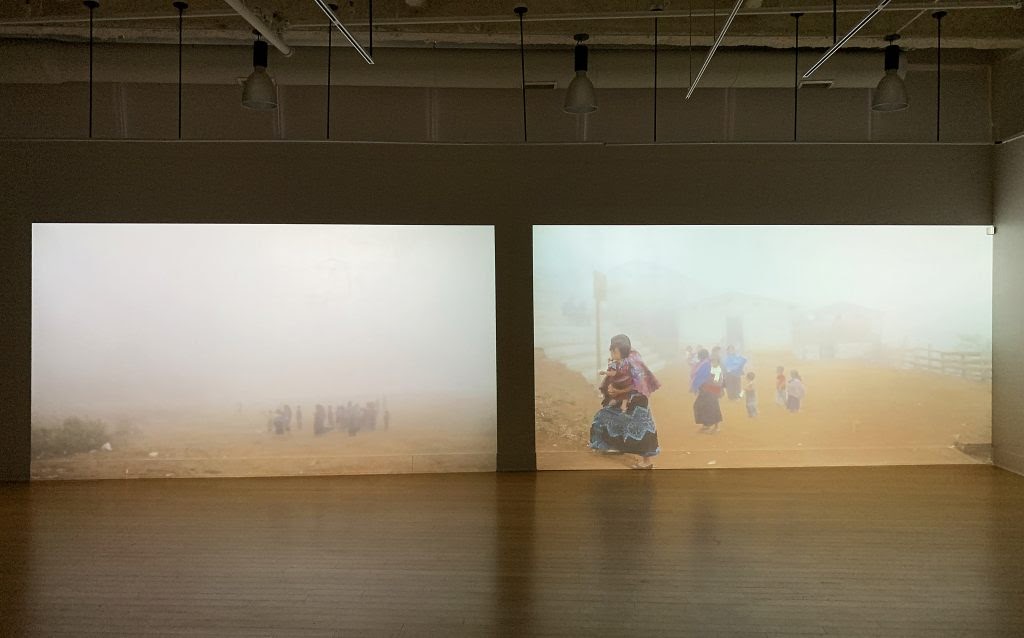
Interview with Mia Eve Rollow The Sailing Stones Act Interviewed by Iona Nave Griesmann Mia, a Chicago native, is a multidisciplinary artist. After receiving her Masters degree from the School of the Art Institute of Chicago (2009), she moved to Chiapas, Mexico where she co-founded EDELO (En Donde Era La Onu/ Where The United Nations Used To Be). As a person who was raised in Chicago, what experiences or education did you have that helped you be able to work closely with communities of Mexico, India and Palestine? While in Chicago, during graduate school, I entered into a time of metaphysical experiences. I will not go into detail on much of it, I will only say I was in a collision where I underwent a physical transformation that lead me into immense pain. However, it also undid the shackles of prescribed reality and my identity as “singular” was wiped away more than ever from then on. Six months later, back in graduate school, I began to re-form notions of reality in this performative entity that was my new body. I began to create costumes and theatrical body performances to act out elaborate strategies intended to break apart my dysfunctional persona, using these metaphysical experiences as my guide. In public, people started to come up to me and tell their own intimate stories of wounds they endured, so these isolated performances soon became community performances extending into larger social and political investigations; everything was interconnected. In an otherwise grey world, I found something that felt very communal and real; this became a foundation for my collaborative work, my understanding of our body, pain and oppression, survival and self-determination, and our deep divinity within. Do you know specifically what led you to working outside of the US? How did studying the art of Zapatistas in Mexico influence your artistic practice? In graduate school I became very close to another student in the department, Caleb Duarte. He invited me to Chiapas to begin the experiment of an art space inspired by the Zapatista Movement. One of the main reasons I went is because I had always been an outcast within my own culture and family, and so I wanted to go where others conversed with the natural world the way I secretly did. A place where this dialogue was intrinsic to the way of life, where the communities ruled themselves in autonomy and without fear. I wanted to see in this type of world; what did “art” look like over there? I wanted to see the power of art as it runs in the veins of Zapatista methodology; they create from a place that is so connected to the stars it can move political mountains. Their way of seeing– their art–creates a symbiotic relationship between the past or the roots, and the present day, or the dream. Because of this relationship, they are not confined by human-made reality; rather they manifest their own myth, they can hear the true chants being spoken from the spirits of the ancestors within the natural world, and they have the wisdom to listen and organize around the whispers. Did your beliefs shift when you became familiar with Mayan Shamanism and Cosmology? The wisdom I found in the peoples’ art was braided into the earth-based healing practices I wove myself into. In this world there has been a historical bleaching of earth-based practices; the indigenous people have been subjugated by those calling their science superstition, their faith heresy, and their wisdom make-believe. When in fact those ‘superstitions’ are the tributaries leading to oceans of truth. Unlike many other artists who make work about their own experiences, you appear to directly channel the experiences and stories of others. What work do you do to make sure that the performance artists in your work are represented profoundly and accurately? In the work that you see in the show I have created nothing myself besides the drawings on the wall. All of the performances were done in collaboration with the people in the pieces. When I say collaboration, I don’t mean they are paid actors and I am the director: I mean they are as much the creators of the myth as I am, from beginning to end. My role is that I come from a background of making this work so I bring a sort of structure within which to create, but once we are inside the structure, it is a very organic and open playing field where the people themselves are determining the actual game with me, and have approved and wanted the work to be shown. Can you tell me more about the “structure within which you bring to create” and the process of making? Under the name of “art”, a free space to act out realities that are unspoken and even unrealized comes about through interviews, film screenings and discussions, sculpture and performance workshops, and by visiting important landscapes both physical and in our collective psyches. We sift through themes that are relevant to the participants both on a local and global level and identify potent symbols in order to create our own game or myth. We use what is readily available and familiar to that particular community – materials, significant objects, healing rituals and bodies of the people – which are worked and alchemized by the participants to capture a meaning they chose. The action itself can be the meaning, and there can also be a message that is hoped to be captured in a film with hopes to share globally. Through this approach, we sidestep any stereotypical tropes of how people may typically be represented, and we enter into a way of creating authentically. We make a way to approach and access ancestral mythic imagination and we hear wisdom from the future. The game masks life and for moments we are playing in our own manifested destiny. The aesthetics are not commercial or produced, they are real happenings, it is magical realism, grounded