
Lewis Colburn: two hundred and forty-two years
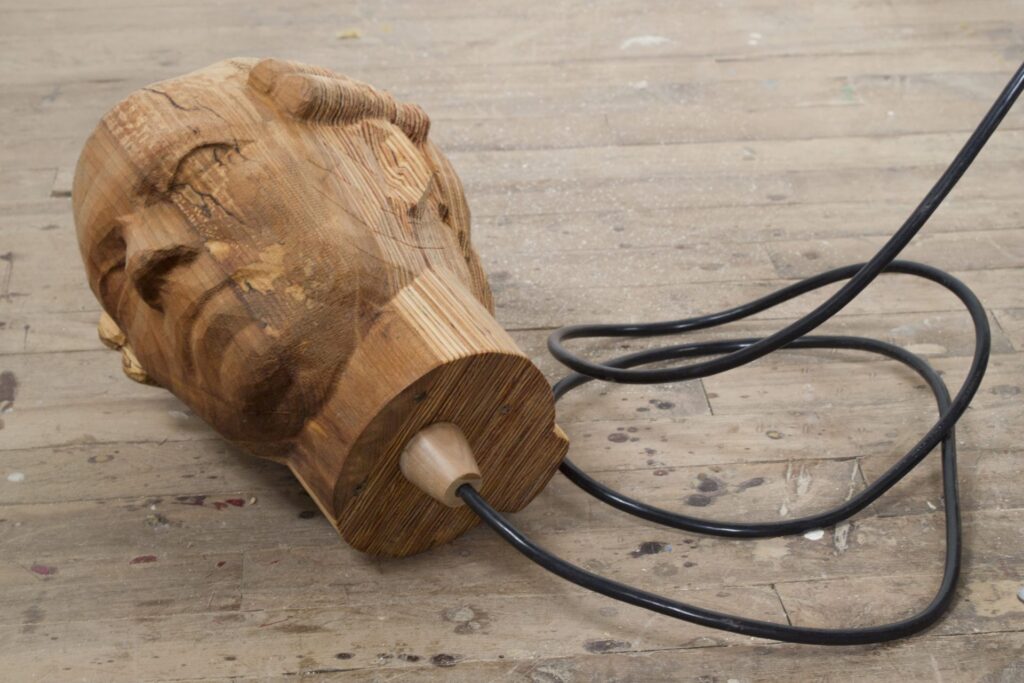
By Noa West, June 21, 2017 VisArts had the pleasure of presenting sculptor and multimedia artist Lewis Colburn’s solo exhibition, two hundred and forty-two years, in the Kaplan Gallery, June 16 – July 16, 2017. Using 20th and 21st century processes such as digital fabrication, 3D scanning, welding, woodwork and mold making to create historically-based objects, Colburn fuses together eras of our time, questioning what is considered authentic, what is considered a replica, and “how the past creates the future.” His work stimulates questions regarding the significance, narratives, and nostalgia associated with historical artifacts. His sculptures and vignettes galvanize the imagination of viewers, urging them to create new narratives and perspectives around the 242 years of America as a nation. Noa West, our summer gallery intern, spoke with Lewis about his ideas, processes, and the two series of works he included in the exhibition: “Early America” and “A State of Permanent Discontent.” Where did you grow up? Did you have fascinations as a child that show up in your work now? I grew up in Cedar Falls, Iowa, a small college town in north-eastern Iowa, and also spent a lot of time in Minnesota as a kid. As far as fascinations— I’ve always been drawn to making things, and my parents encouraged me to do so from an early age. I grew up building things out of cardboard, sewing stuffed animals, noodling around with bandsaws and tools, and making costumes for myself. There’s a kind of pejorative term in writing about science fiction called ‘world-building’, i.e. those places in sci-fi writing where the author spends a lot of time explaining the intricacies of their imagined world, as opposed to moving the plot forward. I don’t think of that as a bad thing, though— I love the idea of world-building. I’ve always been drawn to these constructed worlds- the theater, film, fiction, even the kind of Dungeons and Dragons kind of gaming worlds. I think a lot about re-enactors now (though I most definitely am not a re-enactor and don’t participate in those events) but that’s another place where people are kind of collectively creating their own world. I’m drawn to those events now because they at least in name have some connection to the past, and hence to our world, as opposed to the more imaginary worlds of sci-fi or fantasy. I thought I was going to be an architect for a long time— a kind of combination of problem-solving and making, but then I took my first sculpture class in undergrad and found myself spending hours and hours in the studio. I didn’t really think it was feasible to be an artist, but I just kept at it though grad school and onward, and here I am today. What kind of conversation are you hoping to start when looking at “Early America” and “A State of Permanent Discontent?” With a lot of these artworks, I’m interested in making something that exists between our known categories of objects between museum replica, movie prop, sculpture, theater set, etc. Blurring these lines points to how we shift and change our narratives about the past over time. Usually what we think is important in the past, the lessons we try to extract from it, tell us more about who we are today than anything objective that happened in the past. That’s a long-winded conceptual answer, but those are the high-level ideas I am thinking about. I also want the works to be physically seductive, to draw the viewer in and give them the opportunity to ask questions. If those questions focus on the era I’m dealing with in the work, so much the better. Why name the series “A State of Permanent Discontent?” The full title is, “A State of Permanent Discontent,” though I am still evolving my language. I am think about ‘state’ as a double entendre; a sense that it is a condition also these days, a political unit. Within a state of ‘permanent discontent’ there are always things that need to be pushed forward, approved, made better, and we should never be satisfied with where we’ve come. Your sculptures are powerful in the way that they are simplistic and specific. How do you choose/ narrow down the elements— What guides your decision? Most of the works start from a single object— the cast-plastic waistcoat in the context of The Colonist, the ornate molding in the case of Untitled (Federal Period), etc. I tend to arrive at these things by looking at images and objects from the past; in museums, in books, and also just via Google Image Search. For “Early America,” I also kept a mail-order catalog which caters to reenactors and living history interpreters in the studio, as it’s essentially a huge catalog of readymade replicas. I also let the making process narrow down the decisions. The objects I make are usually at the intersection of visual/conceptual interest and a making process I either know, or am excited to learn more about. From there, once I have one object, I build off of it— creating a kind of infrastructure to hold it in space where I want it to be, and add in objects and elements as necessary to fill out the work. Lewis Colburn, two hundred and forty-two years, installation view of “Early America” in the Kaplan Gallery at VisArts. How does your use of materials, that didn’t exist at the time that these pieces were originally created, formulate your practice and the stories that you push through to people? The plastic/ red resin used in the sculptures of “Early America” is a very clearly artificial late 20th, early 21st century medium. The red resin does belong in that time period, so it emphasizes that it is a replica or a fake, it’s something made now. The red plastic is sort of a new material, kind of candy-like, and it emphasizes the artificiality of these things. The other thing that I think about is the idea that, say that a museum conservator